

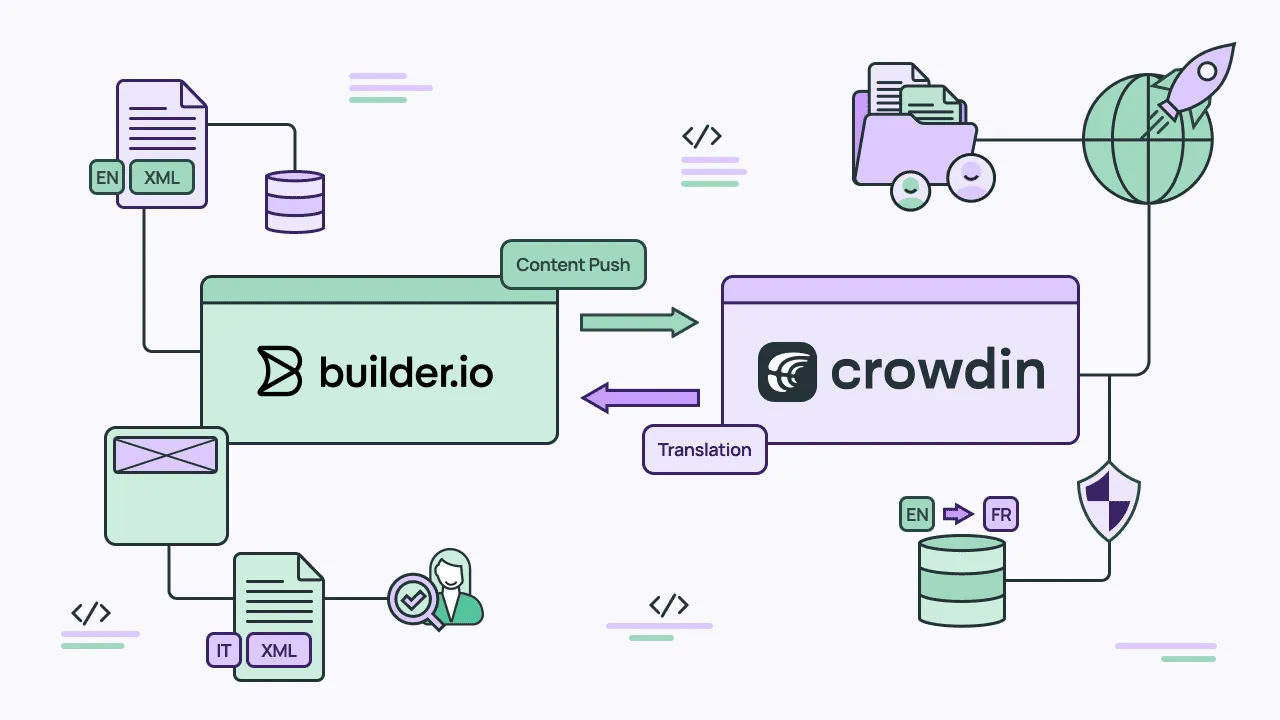
Most teams hit the same wall when expanding to new markets. The content strategy is ready. Translations are in progress. But every new locale requires engineering work to set up, deploy, and maintain. Add five markets, and you’ve added five times the coordination overhead.
The problem isn’t translation. It’s the gap between translated content and live pages.
This post covers how product and engineering teams can close that gap using Builder.io and Crowdin together, so marketing and content teams can manage localization across markets without creating a parallel engineering workstream for every region.
Why localization breaks down at the delivery layer
Localization failures are rare during translation. Most teams have a functional process for getting content translated. The breakdown happens after.
Translated content needs to get into the right pages, in the right format, at the right time. If engineers are responsible for that step, every market update competes with product work for sprint capacity. Regional campaigns get delayed. Time-sensitive content misses its window. And as the market count grows, the coordination overhead scales linearly with it.
The teams that scale globally without scaling their engineering teams have one thing in common: they separate content management from content deployment. Engineers build the structure once. Marketing and content teams manage everything that flows through it.
How the Builder and Crowdin connector works
Builder.io’s Publish product is a headless CMS with a visual editor. Marketing and content teams use it to build, update, and publish pages using components registered by their engineering team. No engineering tickets required for routine updates.
Crowdin is a localization platform that manages translation workflows, translation memory, and multi-language content across teams.
The connector between them links the two systems so that content flows from Builder into Crowdin for translation and back into Builder for publishing, without manual export-import cycles or engineering involvement at each step.
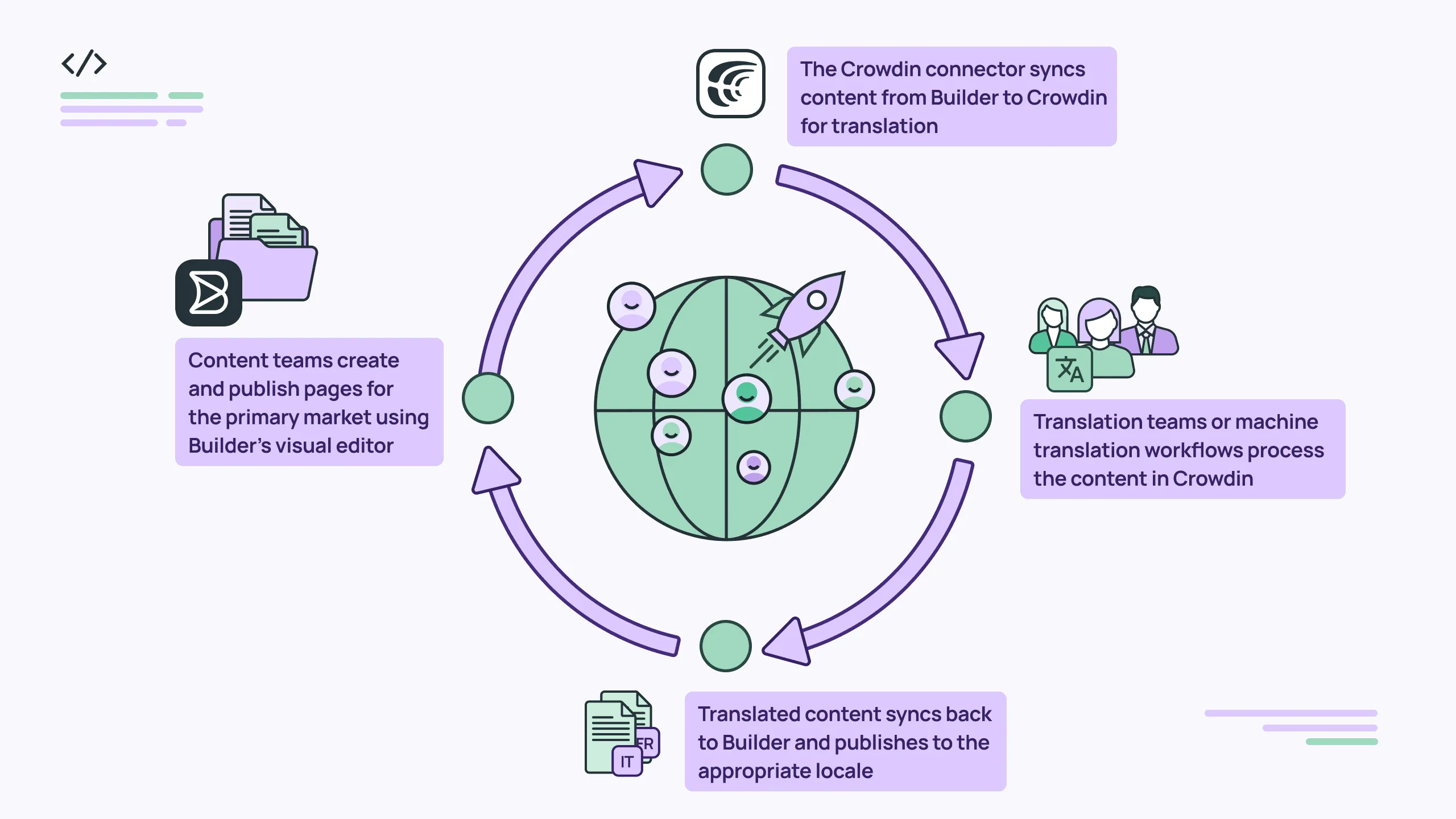
The workflow looks like this:
- Engineering registers components and sets up locale-aware content models in Builder once
- Content teams create and publish pages for the primary market using Builder’s visual editor
- The Crowdin connector syncs content from Builder to Crowdin for translation
- Translation teams or machine translation workflows process the content in Crowdin
- Translated content syncs back to Builder and publishes to the appropriate locale
- Regional variations, whether that means different copy, different imagery, or different component arrangements, get managed directly in Builder by the teams closest to each market. Engineering reviews structural changes. Routine content updates, campaign launches, and regional adaptations happen without touching the dev backlog.
What changes for engineering teams
The default localization model requires engineering involvement at every stage: setting up infrastructure for each market, deploying translated content, handling regional customizations, and supporting campaign launches across time zones.
With Builder and Crowdin connected, engineering’s role shifts. They define the component library and content models. They set permissions that govern what marketing can and cannot change. They review structural or code-level changes.
Everything else, publishing translated content, adapting pages for regional audiences, and running localized campaigns, is owned by the teams doing the work.
For a company expanding to five markets, that difference is significant. Engineering builds the infrastructure once and maintains it. Marketing launches each market on its own timeline.
What changes for content and marketing teams
Without this setup, marketing teams in localized markets are dependent on developers for almost everything. Need a different hero image for the German market? Engineering ticket. Want to run a promotion only for customers in France? Engineering ticket. Need to update the Japanese homepage before a product launch? Engineering ticket.
That dependency slows down regional teams and creates friction between marketing and engineering that rarely resolves on its own.
With Builder and Crowdin connected, regional teams can manage their own content within the guardrails set by engineering. They can publish translated pages, adapt layouts for local preferences, and launch regional campaigns without waiting on sprint cycles.
The guardrails matter here. Engineering controls which components are available and how they can be configured. Marketing works within those boundaries. Brand consistency is maintained through the component layer rather than through manual review of every change.
A practical example: launching a regional campaign
Say your team is running a promotional campaign timed to a local holiday. The campaign needs localized copy, region-specific imagery, and a slightly different page layout than the default.
In a traditional setup, this involves writing a brief, waiting for an engineering ticket to be picked up, reviewing a build, requesting changes, and repeating until the page is ready. For a single market, this might take two to three weeks. For five markets running simultaneous campaigns, the coordination compounds quickly.
With Builder and Crowdin:
- The content team creates the campaign page in Builder using existing components
- The page gets pushed to Crowdin for translation
- Translated versions sync back and publish to the appropriate locale
- Regional teams adjust imagery and layout details directly in Builder’s visual editor
- Engineering reviews and merges any component-level changes; routine content updates are published directly
- The campaign goes live faster. Regional teams have more control. Engineering focuses on higher-priority work.
What to consider before setting this up
A few things to have in place before connecting the two platforms:
Your component library should be stable. If components are changing frequently, the localization layer will require more maintenance. Teams that have invested in a documented component library get the most out of this setup.
Content models in Builder should be locale-aware from the start. Retrofitting localization onto a content model built for a single market creates technical debt. If you’re early in your Builder setup, it’s worth structuring content fields to support multiple locales before scaling.
Permissions should reflect how your teams actually work. Builder’s roles and permissions let you define what marketing can edit and what requires engineering review. That boundary is worth careful thought before regional teams start publishing independently.
The broader shift
Global expansion doesn’t have to mean global coordination overhead. The teams that scale most efficiently build their content infrastructure so that engineering effort stays fixed while market count grows.
Builder and Crowdin together support that model. Engineering defines the system. Content and marketing teams operate within it. Translations flow automatically. Regional teams publish on their own timelines.
The result is a continuous localization workflow that scales with the business rather than with the engineering backlog.
To explore the integration, visit the Crowdin + Builder.io connector.
Localize your product with Crowdin

Amy Cross
Amy Cross is Content Director at Builder.io, where she leads content strategy for an AI-native product development platform. She has spent 15 years driving growth for technology companies from startup to enterprise, with a focus on AI, SaaS, and the platforms reshaping how teams build and ship. Her work spans demand generation, sales enablement, product marketing, and category development, with a consistent focus on content that moves pipeline and establishes market position.